Some press
Here are links to some recent letters, articles, and editorials that have appeared in Massachusetts newspapers. Feel free to use these when communicating with legislators. Editorials in papers that cover a legislator's district can be particularly valuable ammunition.
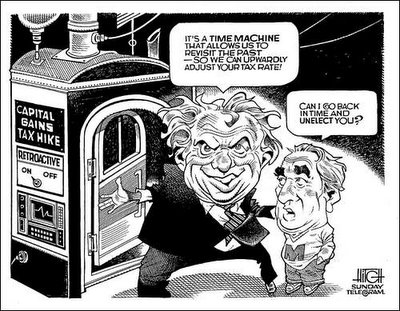
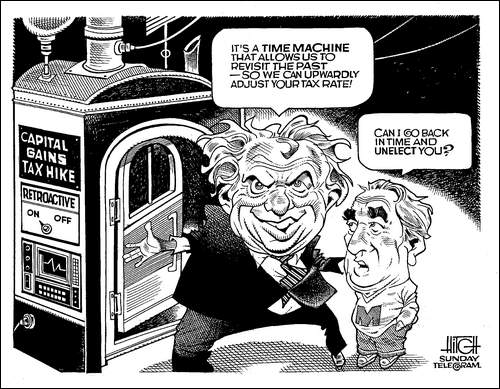
Worcester Telegram & Gazette, cartoon, 11/27: Time Machine
Boston Globe article, 11/10: State is Sending Notification of Retroactive Taxes
Lawrence Eagle Tribune (also in Salem News, Daily News of Newburyport, and Gloucester Daily Times), 11/13: It's not fair to raise taxes retroactively. The text is included in the comments to this post.
Boston Globe article, 11/10: State is Sending Notification of Retroactive Taxes
Lawrence Eagle Tribune (also in Salem News, Daily News of Newburyport, and Gloucester Daily Times), 11/13: It's not fair to raise taxes retroactively. The text is included in the comments to this post.
My op-ed in the MetroWest Daily News, 11/20: Retroactive Tax Sends the Wrong Message
Boston Herald editorial, 11/22:
Revenues boom, no tax cut in sight
Boston Herald article, 11/23: Tax ax ‘terrible policy’: Ex-Fidelity big’s trust fund hit
Boston Herald article, 11/24: New retro capital tax whack takes toll
MetroWest Daily News article, 11/24: Legislature debates retroactive capital gains tax
MetroWest Daily News letter, 11/26: Capital gains tax fiasco
North Adams Transcript, 11/26: Remedies sought for capital gains tax problem
Boston Globe editorial, 11/29: Taxing Common Sense
CBS4, 11/29:
Thousands Stunned By Capital Gains Tax Change
MetroWest Daily News editorial, 11/30: Fix the retro tax mess
Worcester Telegram & Gazette, 11/30: Ax the retrotax. The text is included in the comments to this post.
Boston Herald editorial, 11/22:
Revenues boom, no tax cut in sight
Boston Herald article, 11/23: Tax ax ‘terrible policy’: Ex-Fidelity big’s trust fund hit
Boston Herald article, 11/24: New retro capital tax whack takes toll
MetroWest Daily News article, 11/24: Legislature debates retroactive capital gains tax
MetroWest Daily News letter, 11/26: Capital gains tax fiasco
North Adams Transcript, 11/26: Remedies sought for capital gains tax problem
Boston Globe editorial, 11/29: Taxing Common Sense
CBS4, 11/29:
Thousands Stunned By Capital Gains Tax Change
MetroWest Daily News editorial, 11/30: Fix the retro tax mess
Worcester Telegram & Gazette, 11/30: Ax the retrotax. The text is included in the comments to this post.
posted by Irwin Jungreis at
10:21 PM


2 Comments:
The piece that follows went into the Salem News, Daily News of Newburyport, Gloucester Daily Times, and Eagle-Tribune.
Lawrence Eagle Tribune
November 13th, 2005
It's not fair to raise taxes retroactively
The Massachusetts Legislature is attempting an unprecedented and unfair money grab from taxpayers. Gov. Mitt Romney and some legislators are trying to stop it. But they only have a chance to do so if taxpayers scream with outrage.
Imagine this scenario: You work and pay your state income taxes on time, having the appropriate amount withdrawn each week from your paycheck. Then the Legislature decides it wants to raise the tax rate. But legislators refuse to wait until the beginning of next year to raise the rate. They raise it retroactively back to the beginning of the year. You think you've paid your taxes correctly but you're wrong. You now owe the state a big
check for back taxes.
That's the essence of what the Legislature did -- only not with income taxes but with capital gains taxes. Capital gains taxes are paid on the profits made from the sale of assets such as real estate or stocks.
The heavily Democratic Legislature voted Wednesday to set the capital gains tax rate for all of 2002 at 5.3 percent. That means 33,500 Bay State residents now owe $150 million more in taxes for 2002 -- even though they've already paid every penny of tax they owed under the law that existed at that time.
It's outrageous and completely unfair. But the Legislature is playing the old class warfare game. Most capital gains taxes are paid by wealthy
people. Supporters are banking that the average resident doesn't care if rich people have to pay an extra $150 million.
We should care. There's an important principle involved here: Equal justice under the law. It doesn't matter if an unjust law only affects people we don't like. What's fair for the rich is fair for the poor alike.
Nor is it true that only rich people pay capital gains taxes. House Minority Leader Brad Jones, R-North Reading, opposed the retroactive tax.
His office told reporter Edward Mason that statewide, 354 people with incomes of $5,000 or less will owe an average of $2,250.
This retroactive tax hits residents of communities across the Merrimack Valley, rich and poor alike. Mason found that, according to the Department
of Revenue, taxpayers living in Andover owe $1.5 million. Those living in North Andover owe $828,000; Haverhill, $327,000; Methuen, $240,000; and Lawrence, $146,000.
Remember, these are not tax cheats. These people all paid the full amount of taxes owed on their transactions at the time they were made. Now, three years later, the Legislature wants more.
The Legislature bungled its way into this mess. It first raised the capital gains tax to 5.3 percent on May 1, 2002. Prior to that date, capital gains were taxed on a sliding scale. There was no tax on assets
held for six years or more and a 12 percent rate on those held less than a year.
In 2002, those who had gains prior to May 1 paid on the old sliding scale. These are the taxpayers who owe money now. Those who had gains after May 1 paid the 5.3 percent rate.
But in 2004, the Supreme Judicial Court ruled the whole plan was unconstitutional. The court ruled the Legislature could not change tax rates in the middle of the year. The court ordered the Legislature to pick
either Jan. 1, 2002 or Jan. 1, 2003 as the date the change took effect.
Had the Legislature opted for 2003, the state would owe taxpayers a refund of $275 million.
Romney is expected to send the bill back to the Legislature with an amendment setting the tax-increase date at Jan. 1, 2003. But unless legislators hear outrage from their constituents over this money grab,
they'll likely leave the bill unchanged.
Raising taxes retroactively is wrong. It's bad for the economy to send investors such a message of uncertainty.
If the Legislature gets away with this, there's no telling what it will
try next.
By Irwin Jungreis, at 12/01/2005 12:50 PM
Worcester Telegram & Gazette
Wednesday, November 30, 2005
Ax the retrotax
Capital gains bill flies in face of fairness
In light of new reports that state tax collections continue to run far ahead of expectations, the Legislature should void its vote earlier this month that would create an unnecessary, patently unfair retroactive tax on capital gains.
The saga of the retroactive tax began with the Legislature’s decision in 2002, in the midst of the post-recession budget crisis, to change the way capital gains taxes are calculated. A new flat rate of 5.3 percent replaced the sliding scale based on how long the capital asset was held. However, the state Supreme Judicial Court later ruled that the May 1, 2002, date on which the new system took effect constituted a midyear change in tax law in violation of the state constitution. The Legislature had to choose between making the change effective eight months later on Jan. 1, 2003, or four months earlier on Jan. 1, 2002.
Unfortunately, lawmakers opted for the earlier date, levying a retroactive tax affecting as many as 50,000 state residents, including many of decidedly modest means. In Worcester alone, some 450 taxpayers were retroactively assessed a total of $876,000.
The Legislature now has another opportunity to vote for tax fairness. Gov. Mitt Romney has sent back the bill with a proposed amendment that would make Jan. 1, 2003, the effective date of the tax-law change. That would trigger about $250 million in refunds to people who paid the higher tax on capital gains in the last eight months of 2002. To minimize the impact on the treasury, Mr. Romney also proposed authorizing the Department of Revenue to pay the refunds over three years.
With $1.7 billion in the state’s rainy-day fund and tax collections exceeding projections by an estimated $1 billion this fiscal year, any expedient justification for a retroactive tax that may have existed in the dire economic climate of 2002 no longer exists.
To their credit, a number of Central Massachusetts lawmakers, led by state Rep. Lewis G. Evangelidis of Holden, have joined in a bipartisan effort to rectify the situation. This is an issue of plain fairness the entire Central Massachusetts Legislative Caucus should get behind.
By Irwin Jungreis, at 12/01/2005 12:54 PM
Post a Comment
<< Home